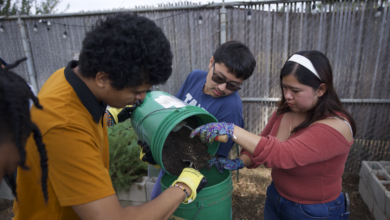
Source: Architects of Belonging
If we’re going to leave something behind, we all have to leave behind why we think it worked for us.
Mary Ann Villarreal, interim president of Cal State Dominguez Hills, left us with this in the final moments of our conversation, when we asked what higher education needs to leave behind if it’s going to come out of this in a better place.
I don’t often start a reflection with how a conversation closed, but with Mary Ann, the ending sits in tension with the story she opened with about her upbringing.
One of the great signs of a leader is the ability to hold two seemingly competing thoughts at once. When we started our conversation, Mary Ann told us about what shaped her growing up: her grandparents adopting and raising her, her sister reading to her and giving her books with her own name in them, and her journey through Mount Holyoke, which challenged her in ways she wasn’t prepared for.
“…my grandmother raising me, adopting me changed my life in a whole trajectory.”
What worked for Mary Ann to become who she is today is clearly rooted in the people who were there for her throughout her formative years. And yet she tells us at the end that we have to leave behind why we think it worked for us.
So how does Mary Ann hold both? She has distilled her own experience down to the input underneath it: “people have not just poured their time and energy, but they have poured love into how I live.”
And when we asked how belonging fits into the way forward for higher education, she put it this way:
The input is community. The input to create belonging has to happen on the input. It’s not an output. It’s not an outcome, right? It is something you start with.
She knows what’s possible when belonging is given as an input. She jokes with students that “Even people on academic probation grow up to be presidents,” and she was one of those students. Behind that light-hearted joke is a serious undertone: when belonging is the input, incredible things can take shape for aspiring students. And she recognizes that her students have the power to make the university better in return:
It’s an invitation to be a part of us and to change who we are to serve our greater communities.
Mary Ann has been focused on building belonging for years. At the University of Utah, she and her team built a matrix to measure it. Now, as interim president of Cal State Dominguez Hills, I’d argue she’s focused on the next frontier: designing the conditions and environments that architect belonging in the first place. You can see it in the family outreach she credits with putting enrollment on track to hit its target, and in her push to front-load tools and resources so first-gen students don’t have to figure it all out on their own.
Each of us remembers our own moments of belonging: the person who saw us, the place that first felt like ours. It’s tempting to build from those memories and hand them to the next generation. But everything around those moments has changed: the environments students grow up in, the pressures that follow them onto campus, and who those students are. What people need from belonging hasn’t changed. They want to be seen, to matter to a community, and to contribute to it.
So the work is designing new moments of belonging that meet students where they are today. I believe it’s one of the biggest opportunities in higher education over the next five years, and it’s exactly what Mary Ann is doing at Cal State Dominguez Hills, giving her students the same feeling those books with her name in them once gave her: this is my world too.
By, Tim Brandt