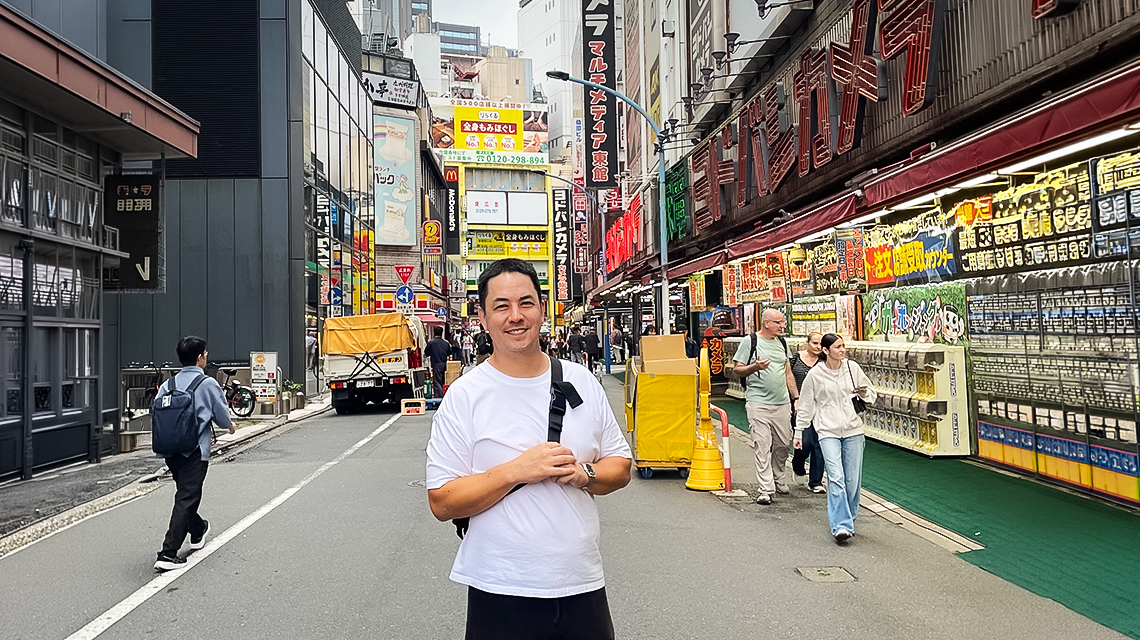
Associate Professor of History Kerry Shannon will spend the next six months in Japan as a winner of a 2026-27 Fulbright U.S. Scholar Award. Shannon plans to use much of the time working on his particular research interest: the history of the toilet in modern Japan. While abroad, he will be studying the design, economic, and public health history of the device, with plans to write a monograph about his findings.
Half of Shannon’s travels will be funded by the Fulbright grant, the other half on a Japan Foundation grant, which Shannon says, “might be characterized as the Japanese government’s equivalent of the Fulbright.”
The professor will spend most of his time in Tokyo, where the National Diet Library is located. “I’ll also make at least one trip to Nagoya, Japan’s third-largest city, and the former center of porcelain production,” says Shannon. “The city was also comparatively quick to install an underground sewage system.”
“The grant is wonderfully independent,” Shannon continues. “Although I am sponsored by Umemori Naoyuki, a professor of political thought at Waseda University, my time will be spent as I design it.”
Shannon plans to find as many different toilets as possible during his stay. “We take toilets for granted,” he says, “but the devices tell us a fascinating story of Japan’s modern history, from squatting over a bamboo box to current bidet ‘washlet’ varieties.”
Shannon joins 25 California State University (CSU) students, recent graduates, and faculty members who have been selected for the student and scholar awards. The Fulbright program is one of the most prestigious international fellowships, awarded to approximately 2,000 students and 800 scholars each year. Established by Congress in 1946, the program aims to foster mutual understanding between the U.S. and other countries.
Chosen for their academic merit and leadership potential, awardees study, teach, conduct research, exchange ideas, and collaborate to develop solutions to international challenges through various program offerings.
“The Fulbright is crucial for promoting cultural exchange,” says Shannon. “The grant enables researchers, teachers, and students to immerse themselves within different global contexts and then promote their findings within their home country. During a time when social media and AI are leading to atomization, the Fulbright encourages cosmopolitanism and international exchange.”
As for his own work, Shannon says, “People often wonder why Japanese toilets are unique and uniquely advanced. I hope to provide some answers to that query.”