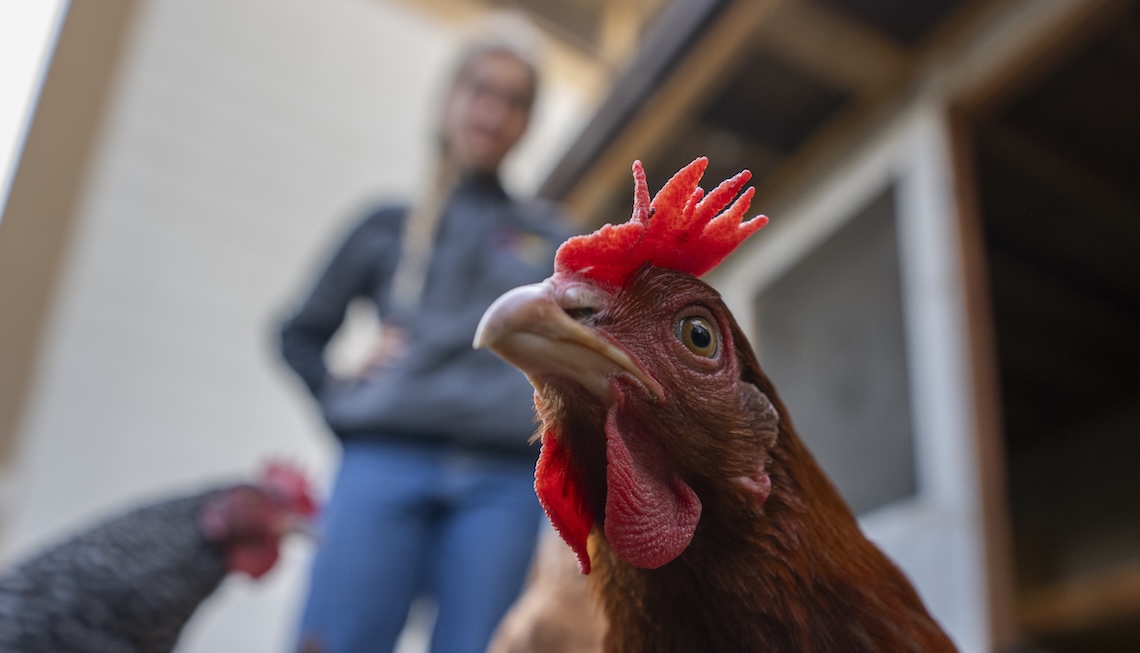
The CSUDH Urban Farm has been a fixture on campus since 2018, providing a living laboratory where students can learn about sustainability and green jobs while helping fight food insecurity. After an incident with an unknown predator last year, though, it was missing a vital component: farm animals. But a little extra life got injected back into the farm in late May, when 12 mixed-breed chickens took up residence, bringing their energy, noise — and eggs — to the project.
“The chickens bring life to this farm,” says Environmental Studies Lecturer Alicia Salmeron-Blaisdell, who teaches courses on urban farming at the facility. “They also help with pest control, so we can use less chemicals.”
The chickens’ newly secure coop was custom-built from scratch by CSUDH’s in-house Facilities Services carpenters. The new coop was designed to provide a stronger and safer home for the chickens while also providing great ventilation for very hot summers and wet winters.
“Having chickens back at the Urban Farm makes the food-system story more complete,” says CSUDH Sustainability Coordinator Aemelia Hellgren. “They help students see that regenerative agriculture is not only about growing crops, but about how animals, soil, food waste, and people can work together in a more circular system that benefits all parties.
“They also provide hands-on opportunities for students to learn about animal care, food production, responsibility, and the realities of raising animals ethically in an urban environment. Also, for many students, especially those who have not spent time around farm animals, the chickens make the farm feel more welcoming, memorable, and alive.”
Bertha Valdes, a student in the beginning urban farming class, agrees. “The chickens are so friendly and so loving, they’re really fun to be around.”
The farm is more than just chickens, though. It grows a variety of fresh fruit and vegetables in raised beds, and all the food that is grown and produced at the farm gets donated to Teddy’s Pantry on campus, to be distributed to students for free.
“The farm demonstrates what a local, regenerative, and community-centered food system can look like on a small scale,” says Hellgren. “At the same time, the farm makes fresh produce more accessible to students. While the farm can’t produce enough food to feed the entire campus, it contributes toward food security and demonstrates what a more resilient local food system can look like. It also gives students a tangible connection to where their food comes from.”
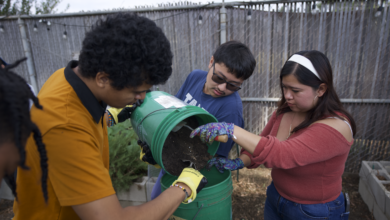
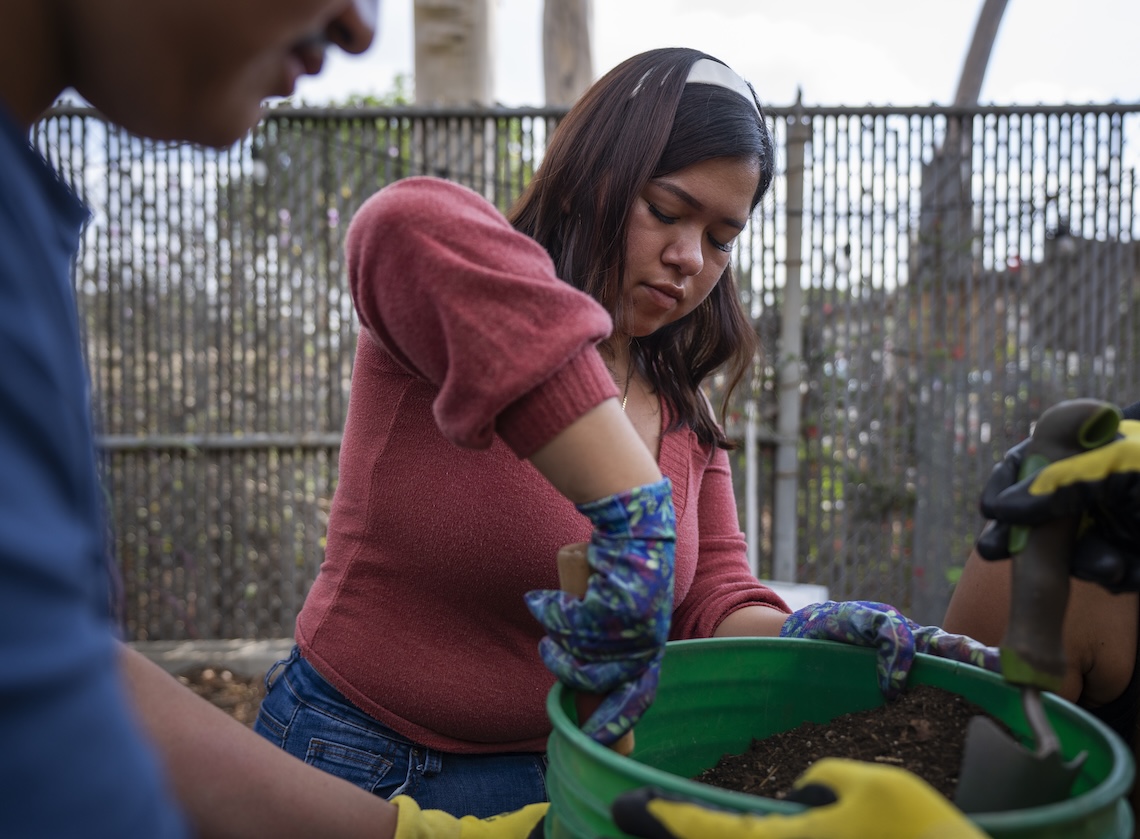
“We give students opportunities to get their hands in the dirt, to see things from start to finish,” adds Salmeron-Blaisdell. “From setting the soil to planting the seeds to harvesting for Teddy’s Pantry, they get to see the full cycle. This allows students to not only see where their food comes from but to be participants in where their food is coming from.”


For Salmeron-Blaisdell, teaching classes at the Urban Farm is a full-circle moment. A CSUDH alumna, she was the very first student intern to work at the farm when it opened in 2018. “I saw this as a dirt pile come to life,” she says. “We had just six beds and now we have more than 18. I got to help break the ground here!”
“The thought of having a farming class was just a seed that was planted in 2017, and to see it come to fruition has been absolutely mind-blowing. Between sustainability, facilities, and all the faculty that wanted to see this happen, they made it happen. And now we get to teach here!”
Students in the urban farming classes do the majority of the work on the farm, planting and harvesting vegetables, fruit, and flowers, as well as feeding the chickens and performing maintenance throughout the project.
“It’s been fun,” says physics and engineering major Ethan Ung. “I’ve learned how to use many farm tools, and how to properly plant — not just ripping the plants out of pots and tossing them into the soil. It’s hard work, but it’s been a lot of fun.”
“I invite everyone to come out here and take a look so they can experience this,” says Valdes.
The Urban Farm is holding an Open House on Thursday, October 8, 2026, from 10 a.m. – 2 p.m. for students, faculty, and staff. There will be farm tours, free mocktails made with farm-fresh herbs, and hands-on table workshops including soup-making and more. Volunteers may participate in tree planting from 10 a.m. – 12 p.m., and there will be a 12 p.m. ribbon cutting to celebrate the new chicken coop.