When Assistant Professor of Women’s Studies Anat Schwartz was looking for community organizations to partner with for a new course, she didn’t have to look any further than her phone. She was already following a potential partner on Instagram: the Compton G.IRLS Club.
“I love the work that they do and had been following them,” says Schwartz. “So when I was trying to find good organizations to partner with, they were a natural choice.”
The course, Women’s Studies 300: Community Organizing, Activism, and Gender, brings CSUDH students into the community to assist local organizations – while also learning the real-world skills needed in activism and organizing.
Schwartz contacted the founder and director of the G.IRLS Club, Chrystani Heinrich to see if her students could help in her work. “She sent me an email that said she loved what we’re doing, and asking if there was any way for her undergraduate students to partner with us,” recalls Heinrich.
“I thought about it for a while and realized there were probably things that I don’t have the range to teach, but maybe the students do.”
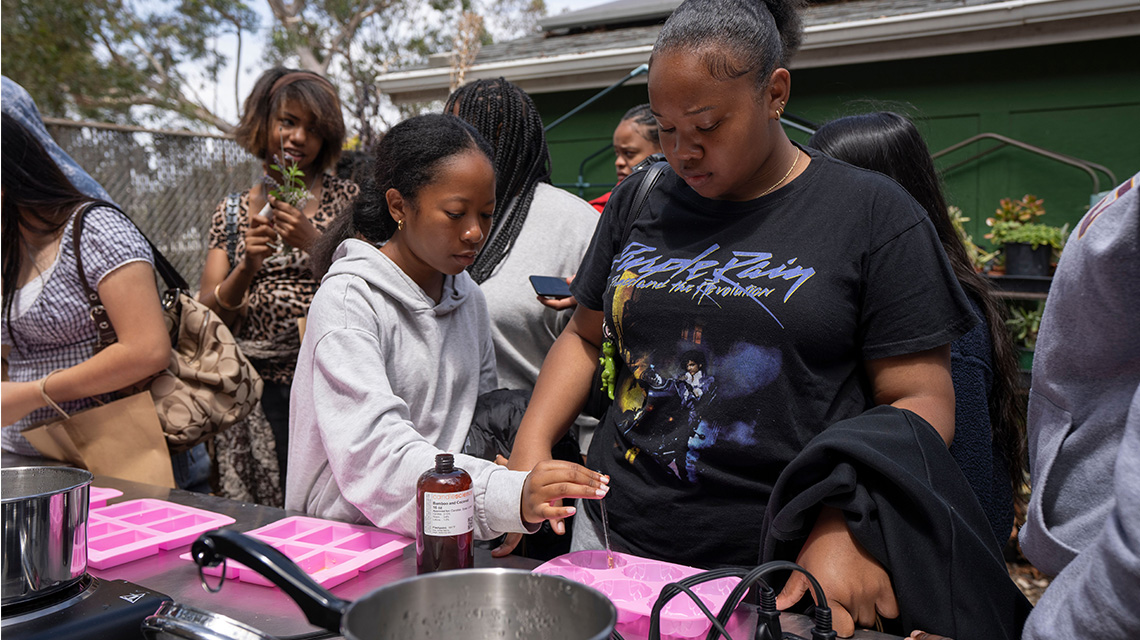
The G.IRLS Club holds workshops every Saturday, where the girls learn about new subjects or skills – including preparing for college and the world after high school. “It’s something new every weekend,” says Heinrich. “We’ve learned about everything from how to do 3D rendering to surfing and cryptocurrency!”
Heinrich worked with Schwartz and Toro students to create new programming for the club members. On Wednesdays, they ran sessions on college and life skills through College G.IRL, as well as leading an advocacy and activism program called G.IRL Power. Toro students also organized a field trip to CSUDH for 30 members of the Compton G.IRLS Club as part of their Saturday programming.
“It’s important that my girls see people who are close to their own age,” says Heinrich. “It’s not like some old aunties telling them about college. No, these are undergraduates just a few years older than the girls, so they’re telling them the real experience and what to expect.”
The course continues to evolve each year, as Schwartz and Heinrich see what works well and what doesn’t. “Every time you do a partnership, it’s an opportunity to think with your students about the community partner who is collaborating with you,” says Schwartz. “But we’re also thinking about the youth we’re serving. Is there something we could be doing better or differently with them?”
“We’re thinking very creatively about how community-engaged courses serve our students’ career readiness, but also what serves the community partners’ needs.”
CSUDH student Samantha Gutierrez, a double major in Women’s Studies and Political Science, was a student in the first iteration of the class in Spring 2025. She now supports the course in her role as a Student Fellow with the Center for Community-Engaged Teaching and Research. “I’ve seen how this course really transforms you as a student—personally, academically, and professionally,” she says.
“Through this course, I’ve been able to fully understand what it means to work with the community collaboratively, to act ethically, and with a lot of care.”