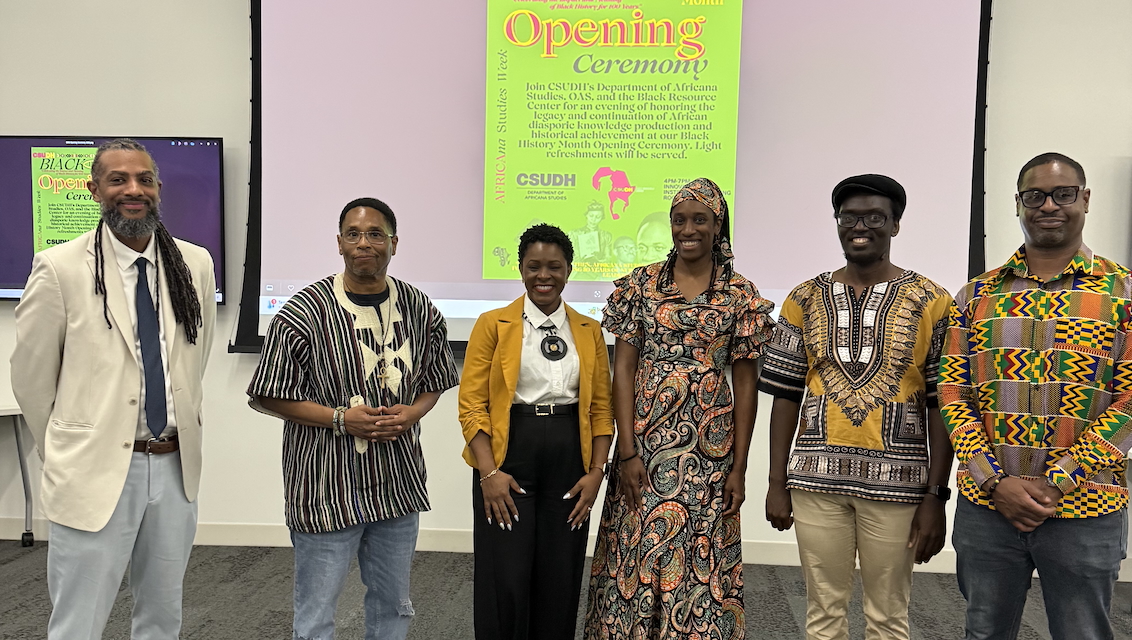
Black History Month 2026 was a special one at CSUDH. Not only did it commemorate 100 years of Black History celebrations, but it also served as the 30th anniversary of the founding of the Africana Studies department. Events were held throughout the month to celebrate these twin anniversaries.
Spearheaded by the CSUDH Africana Studies department, this year’s events included an opening ceremony, a department open house, film screening, and a Martin Luther King Jr. Memorial Symposium.
Originally celebrated as Black History Week, the annual celebration was created by historian Carter G. Woodson in 1926. Woodson “charted the course for bringing national awareness to the importance of black history,” says Africana Studies Chair Salim Faraji.
Black History Week evolved into Black History Month in the early 1970s and was officially recognized by President Gerald Ford in 1976. It continues to resonate because “this knowledge, information, and history has to be reinforced in every generation,” according to Faraji.
“People of African descent were here prior to the founding of the country,” he continues. “Of course, they participated in the founding of the country. But people try to suppress that knowledge, so that’s why the job is never done. We need to reinforce these values and principles. You can’t take it for granted.”
The Africana Studies department actually started life in the late 1960s, but as an interdepartmental concentration in Afro-American Studies. In 1995, the CSUDH Africana Studies became an autonomous, degree-granting department. The campus has been celebrating this anniversary throughout the 2025-26 academic year.
For Faraji, the creation of Black and Africana Studies departments is worthy of commemorating because “it’s democratized higher education.”
“It’s so very important that we understand the multiple cultures that contributed to the founding of this nation,” says Faraji. “When you look at documentary sources, it’s impossible to ignore the histories and cultures and contributions of the multiple people who have set foot on these shores.”
Faraji notes that the creation of Black and Chicano Studies departments was driven by student demand and activism. “Students requested and demanded a more inclusive and fuller participation in American higher education. The creation of Black and Chicano Studies program opened the door for Asian-Pacific Studies, Women’s Studies, LGBTQ Studies, and so on. It’s important we highlight these histories.”
This was the first Black History Month celebrated at CSUDH since its designation as a California Black-Serving Institution, Faraji noted.
“The designation allows us to formally focus on equipping and empowering Black students at CSUDH,” he says. “We’ve actually been doing this work for quite some time, but the BSI designation gives us some official power and will help mobilize resources that are more focused and concentrated on student needs.
“CSUDH was one of only three universities in the CSU system to earn the BSI designation. For me, that’s very powerful.”