Source: Carnegie Foundation
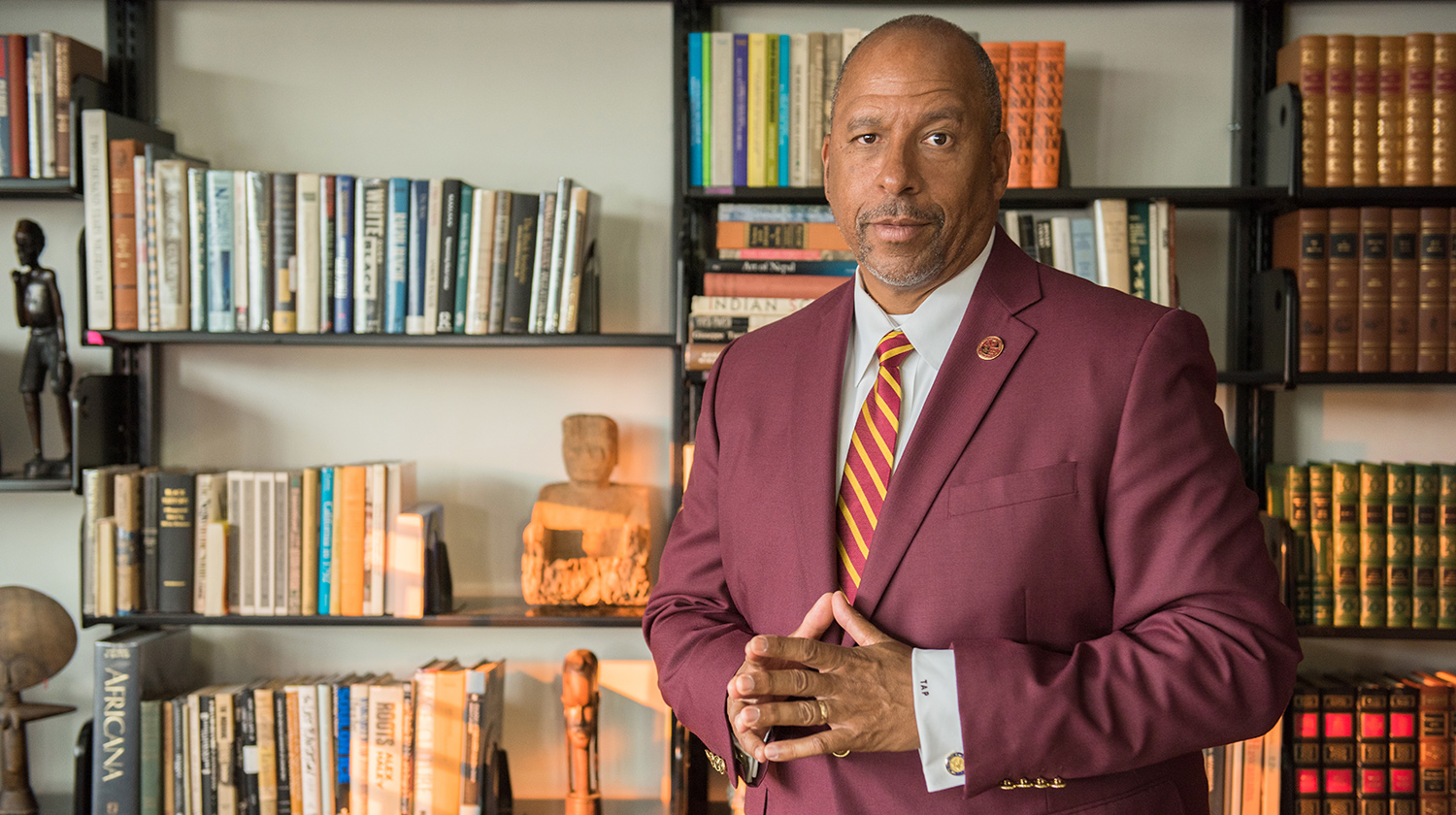
Delve into this thoughtful Q&A with Dr. Thomas Parham, the 11th president of California State University, Dominguez Hills, where he shares his professional journey and the transformation work that has undergirded his leadership tenure. With over 40 years of higher education experience, President Parham discusses why the new Carnegie Student Access and Earnings Classification, focused on student success, represents a critical tool for uplifting the extraordinary work the Cal State system and others are doing across the country to advance economic opportunity for their students.
Dr. Parham is a distinguished psychologist with more than 40 years of combined experience as an academician, executive administrator, scholar and practitioner. Before his presidency at Cal State University, Dominguez Hill, he served as vice chancellor for student affairs and adjunct faculty at the University of California, Irvine, where he had been since 1985. Dr. Parham has served in many key administrative roles in higher ed, and began his career with an appointment on the faculty at the University of Pennsylvania in Philadelphia. Dr. Parham served on the Carnegie Classifications Institutional Roundtable to provide strategic guidance on the development of the updated classifications. He will be retiring from his role as president of Cal State University, Dominguez Hills, effective December 31, 2025.
Please share a bit about your personal educational experience and upbringing. How did your early experiences inform your career trajectory?
My journey to the presidency is an interesting one. I’m a psychologist by training, and a culturally centered one at that, who was delighted to be an academician. I love doing clinical work and seeing patients, teaching in the classroom, doing my research and scholarly work, and then consulting and administration. Somehow, though, my career has moved through this trajectory over the last 43+ years. It was kind of the fulfillment of a projection, if you will, from my mentor, the great Dr. Joseph L. White, from the University of California, Irvine, who was the contemporary father of the Black psychology movement.
Short story: I grew up in LA, in a single-parent household. I’m a product of public and parochial school education, and then went on to college at Cal State University, Long Beach, where I was determined to be either a police officer or an attorney. When I was young, my mom said, “Son, you have no business complaining about anything unless you’re willing to put something better in its place.” And so I grew up amid the ’60s and the ’70s with a mama who raised four kids by herself, worked for the federal government 32 years, and never earned more than $18,000 a year. I learned very early on about inequity and unfairness, both in watching my mom and watching the streets. When I went to college at Long Beach State, it had the largest criminology department in the western United States, so it was a good place to be if I was going to be an attorney or a police officer, but I was frustrated with my education there. I both perceived many of my faculty as racially biased, and learned that the criminal justice system was really about whoever had the best counsel and could manipulate the system the best, and that violated my spirit about why I wanted to get into the field in the first place, which was to help people and make a difference.
Fortunately, while at Long Beach, I got involved in what we now call co-curricular or service learning. I participated in an educational participation in the community program. Based on that experience, I then summized that part of knowing what you want to do in life is not just figuring out what you’re interested in, but also what you are good at, and based on supervisor feedback, I had a knack for this work. Ultimately, I left Long Beach and transferred to the University of California, Irvine, which changed my whole trajectory. The educational ambiance was rigorous, and I had mentoring from Joe White, and it was clear that I wanted to be a psychologist. After graduate school, it was reported that I became the first African-American academic psychologist the University of Pennsylvania ever hired in its 240-year history after it was founded by Benjamin Franklin in 1740.
What brought you to become President of Cal State University, Dominguez Hills, and what do you most admire about the university?
After my work at Penn, I was recruited to be at the University of California, Irvine, where I thought I’d stay for five years before going back to full-time faculty. 33 years later, I was still at Irvine, serving as an administrator, faculty member, scholar/researcher, and clinician, when I got a call from former President Willie Hagan, who said, “This is an opportunity you need to take a look at as I’m getting ready to retire at Cal State University, Dominguez Hills.”
Dominguez Hills spoke to me. I applied and was lucky enough to be chosen as the 11th president of Cal State University, Dominguez Hills. I love the social justice nature of the campus. I love the fact that the California Master Plan has three legs: Excellence in academics and research, access to the state citizenry, and affordability. What I love about the CSU is that it provides access. When I came to Dominguez Hills, I announced that we would not judge our worth on selectivity ratios, but rather we would judge our worth in the Cal State system and at Dominguez Hills in particular, on how many students we can admit and how many lives we can transform.
This is a magnificent institution that has allowed me to do that. Under my tenure, I’ve developed relationships with folks, and this whole community has really embraced me as president and embraced this vision to dream about what’s possible, instead of settling for what’s traditional and predictable.
Please describe your leadership approach at CSU Dominguez Hills.
I recognize that leaders are only as good as the work produced by the people who work with and for them. Any good leader worth their salt understands that. My job is to provide strategic vision, appropriate consultation, cultivate individuals, invite folks to step aside if they are not aligned with the vision, and surround myself with good, competent people. Ironically, while I have created some of it, I’ve not had to create a lot of the excellence that you now see; I’ve simply had a chance to reveal the excellence that remained more latent than visible.
My vision and mantra as president are as follows:
- I start with the idea that there’s no greater blessing in life next to being a parent than being entrusted with the personal and intellectual growth and development of students. My students range from 16 years old to our oldest graduate, who just broke the record last year for receiving a BA degree at 80 years of age.
- I tell my faculty and staff not to guess if students are ready for Dominguez Hills, but rather, to consider: “Are you ready for these students?” As I see it, each student is a seed of divinely inspired possibility, and if we can nurture them in the proper context, they’ll grow into the fullest expression of all they are supposed to become. CSU Dominguez Hills is the soil into which these divine seeds of possibility are going to be placed and if we water the soil with the drops of intellectual enrichment, if we nourish the soil with the values of nurturing and socialization, if we till the soil to remove the weeds of social distraction out of their lives, and give them enough sunlight of affirmation to make them feel good about being here, and affirm their sense of humanity, and give them just enough shade of critique, then we just stand back and watch them grow into the fullest expression of all they are supposed to become. Our students thrive in that kind of environment.
- CSU Dominguez Hill is a destination campus, not a default campus. I invite external stakeholders to embrace that ask while I ask my faculty and staff to dream about what’s possible, and stop settling for what’s been traditional.
- We need to own success rather than rent it. I tell my faculty that there is a difference between renting and owning success. While you take pride in the A’s and B’s students achieve, you also need to own the C’s, the D’s, the Fs, and the withdrawals. This is all of our jobs to be in that space.
CSU Dominguez Hills has recently been named an Opportunity College and University (OCU) according to the Carnegie Student Access and Earnings Classification for being a leading institution in generating opportunity. What practices or processes drive student success on your campus?
In practice, we blew up our advising model and made it less centralized and more college-based and specific. We strengthened student supports, pursued a culture of care, and put a brand new strategic plan in place. Now, people are in a space where they think it is possible to make this vision come to life at Dominguez Hills. Along the way, we’ve seen new curricula and have more academic accreditations now than we ever have in our history. My message of striving for student excellence and being a snob for our students has rippled throughout the whole campus community. So not only are we an Opportunity College and University and in several national rankings, but we also have the educational excellence that reflects where we should be as a state system.
This is reflected in the numbers, too. Two years ago, our retention rates for first-year full-time freshmen and transfers were up 8%, and this last year, the numbers were up 6.5%, so we’ve risen 14.5% in two years. This is due to my incredible student success team and superb cabinet, who have aligned around this shared vision. This work takes time, and it’s amazing to see the efforts we’ve cultivated over time to dramatically increase retention and graduation numbers for our students.
As President of CSU Dominguez Hills, you served on the Institutional Roundtable to help reimagine the Carnegie Classifications for Higher Education. Why is this work important, and what do you think the new classifications will mean for higher education in the decades to come?
Sitting on the Institutional Roundtable for the Carnegie Classifications was one of the honors of my life. It goes back to what Joe White, my mentor, first taught me: “Produce enough excellence, excellence will bring you opportunity.” At the Raise the Bar Summit, hosted by then-Secretary of Education Miguel Cordona, I was invited to present the argument that colleges and universities should not judge their worth based on selectivity ratios, but on how many students gain access to their universities and how many lives they transform through social and economic mobility. Ted Mitchell, President of ACE, was at the Raise the Bar Summit, and called me a few weeks later to invite me to join the committee, presumably because of my perspective and passion for the work, and my ideas for bringing social and economic mobility as a factor that should be measured and assessed in higher ed.
Over a year and a half, I collaborated with other university presidents on the committee, and I was proud to be the only CSU voice in the room. Collectively, we said there ought to be something more than the dollars you have and the number of doctoral programs and students you train to determine classifications. We need to include other variables and factors because it’s more nuanced, and it’s more integrated and complex than just those simple variables. And looking at the CSUs, 15 of the 23 CSU campuses are now designated as Opportunity Colleges and Universities. Elevating the CSU in that space is one of the pride points of my career.
This work—along with that report we did on Black student success coming out of the Juneteenth Symposium I hosted, which was the first one in CSU history—is an institutional achievement that will live way beyond individual leaders, like myself, because that represents systemic change. Now, the Carnegie Classifications provide a more accurate mirror and portrait of what institutions represent, particularly in some of the urban universities around the nation, which are doing the great work for their students.
Many people say that higher education is having an existential moment with enrollment dips, ballooning debt, and declining public confidence. How do you feel about this moment, and how can we ensure that postsecondary education remains a vital engine for transformation and opportunity?
Indeed, this is an existential moment, but education, and higher education in particular, remains the civil rights issue of our day. In spite of the times, the one word I would use to describe my perspective, spirit, and posture is, in fact, hopeful. I’m encouraged. I am almost grateful for the moment. As Sheryl Sandberg said, we need to “lean in,” even to the crazy. It sounds a little strange, but here’s what’s true: In my office, I keep a picture of Martin and Malcolm on the wall as well as a picture of the ancestors and the slave dungeons in Elmina and Cape Coast, from when I visited Ghana, Africa. Collectively, when I have a bad day or when I think the challenges of our day are too overwhelming, the ambiance in my office reminds me to always contextualize struggle. What I know is that we’ve been through worse than this and trouble don’t last always.
When we think about the social context, higher education simply cannot afford to lose its way or to be diminished in importance. Higher education has to be true to its mission of trying to help educate folks, to facilitate innovation and creativity, to help students discover and learn more facts and data, to help students form more cogent and persuasive arguments, to embrace this grand experiment in democracy and diversity that we have, and to learn how to respect, support, and affirm the dignity and humanity of every member of the human family.
As the CSU, we are the largest system of public higher education in America. We take a backseat to nobody in that regard, and make good on the lives we change, the lives we transform, and the people we educate. We should be boldly stepping out to say we’re going to keep on keeping on. The question is: How do we sustain some movement and momentum in the face of the adversity higher education is confronting? And that’s why I’m confident that we’re gonna keep on keeping on. I’m hopeful.